Today marks the two-week point of the Epic European Journey and I find myself in the cushy lobby of our hotel in Naples. Because this lovely Mediterranean city is known affectionately as the Crime Capitol of Italy, Shannon and I opted for a safe, central hotel as opposed to the many other somewhat-more-sketchy options for housing.
Besides the safety factor, it has felt incredible to have a single bed to sleep in multiple nights in a row. Having a constant home base to return to as we adventure about, one where we are not limited in sleeping hours or ever-changing roommates, is quite welcome. In addition this certain hotel has an insane terrace looking over the bay of Naples to Mount Vesuvius, upon which a truly decadent complimentary breakfast is served every morning. We've taken to stocking up on free (O, how I love the sound of that word!) fruit, yogurt, marmalade cake, croissants, tea, and fresh-baked Italian pastries with unpronounceable names.
We rolled in to this city late late late on Thursday night, having sadly flown out of Marseille and hopping a train from our landing in Rome to Italy's third city. We saw just enough of Rome on our stopover to get scalped on some pizza that was worth it, sit in a Roman square where we were hit on by passersby and overshadowed by ornate atlases and cartydids, and see the hippodrome as we flew over. Our train between the two was predictably late and sketchy, the only way for an Italian train to be (no thanks to Benito Mussolini, whose regime had lasting impact only in the latter attribute and not the former). Salesmen wandered between the cars, shoving sleep masks and wilted roses under our tired faces until we made enough grousing noises to head them off to another cluster of seats.
The Italian countryside was pitch dark and thus we were unable to see much of it until the following morning when we threw open the curtains of our eighth-story room to reveal the aforementioned panorama of Vesuvius, volcanic farmlands, red-tiled roofs, majestic domed churches and a few very imposing castle-type things jutting out into the bay. We had learned the night before, much to our extreme delight, that the final races in the America's Cup world series would be taking place that day on the bay. America's Cup is a serialized sailing race that is run yearly on the seas of the world, belying its name. Teams of five sailors maneuver their ultra-light multi-hulled boats around a rather intricate course, with the wind tipping them nearly on beam-ends and making it one heck of a spectator sport. After our leisurely breakfast, we made our way through the city to find he boardwalk and a spot for the race.
I can't begin to do justice to Naples without pictures. Though it is reportedly the dirtiest city in Europe, behind the piles of trash and destroyed masonry lurk fantastic buildings from every style between now and the Romans. It has its share of renaissance churches and baroque storefronts, intricate gated villas and massive buildings that once served as bishops' palaces/arsenals/bureaucratic edifices of state/pretty much anything else. I purposely stay far afield of Italian history because it tends to be one of those subjects that scholars care about much too much; I once ran across a multi-volume debate between some of the brightest minds in the discipline arguing over the merit of the calves on a statue of Hercules housed, consequently, in the Naples Museum of Archeology. One scholar thought that these calves were ideal pieces of art while another opined that the tendons were too prominent by half; a third submitted that their structure was too massive and were an outrage against the tradition of perfect Italian sculpture. Even Goethe weighed in on the negative side, and when Goethe writes about something you know it's a big deal. Anyway, that kind of significance attached to a pair of marble calves unnerves the historian in me and makes me fear for what scholars of Italian history might do when given the significance of a battle, a king, a technological discovery of note. If there exists that volume and pitch of research and drama about a pair of calves, what might they do with something ha actually matters? Most likely beat it to death and expect everyone to know why, i'd wager.
But I digress! I meant to say, before the controversial calves interlude, that Naples was so fascinating and beautiful as to arrest my interest and make me want to know more, despite my aversion to its national past.
One extremely impressive sight all throughout the city is the abundance of gallerias (covered markets with vast, echoing interiors and magnificent decoration) that spring out of city blocks like camouflaged elephants. One minute you're strolling down the street, eating some stracchiatella gelato and musing over which sailboat has the right of way when they share a tack (the windward one, obviously) when you run smack-dab into a five-story behemoth of filigree and glass, with wee angels skipping about above your head and peaceful tile horses grazing across a mosaic below your feet. You weren't looking for this massive structure, per se, but now that you've seen it you'll be recognizing them left and right for the rest of your time in the city. Much like those elephants I mentioned before, you realize that they were not hidden very well at all, as such a large entity is difficult to conceal, and that these huge lovely things are quite obviously prevalent despite the attempts a few city planners to disguise them with the rest of the storefronts.
At any rate, we wandered this incredible city for most of our first morning there, getting our bearings and being endlessly bombarded by street vendors and random Neapolitans to buy things, take photos with them, go into their places of business, marry them... Overall, i would say that Italians (or, Neapolitans at least) are exponentially more friendly than their Gallic brethren. Besides that fact Naples could almost be mistaken for Marseille in some regards. They share general plans of architecture and climate, and the culture is dictated by proximity to the Mediterranean more than by national affiliation. Sometimes the only noticeable difference was the exchange of rues for vias, patisseries for patisserias, and bonjour for boun jiorno. But going back to the people, we made a surprising number of friends who just wanted to shoot the breeze for a while, a new feature of this country when compared to others.
After lunch (in the native city of pizza, it was only natural that we eat it) we took off for the waterfront and, after perusing the impressive dockside display of America's Cup swag, found a comfy seawall to sit on and watch the race. It was absolutely mesmerizing to watch the teams of sailors, hardly visible across wind-chopped waves, run across their boats and back again, cranking at sails and leaning to counterbalance the tilt of the vessel. Sailing is a notoriously difficult sport to watch from shore and I felt rather like this for the better part of the race:
http://m.youtube.com/watch?v=1bngGgqdtVg
That evening, we cruised one if the swanky club districts but did not go clubbing at all.
The next morning we ventured to the other half of the city, with our sights set on the Museum of Archeology, the Botanical Garden, catacombs, and Saint Chiara's monastery and church. We had to go leaping down a few winding, cobbled streets no wider than my kneecap at some points, often sharing these byways with speeding vespas and/or shouting storekeepers. This detouring allowed us some spectacular views of the city and access to some exceptional hidden gelaterias. We eventually made our way to the museum, which had an impressive collection of statuary and artifacts from those illustrious years before Christ, and were summarily followed by a docent who didn't want us putting our unclean American paws on the time-honored toe of some Hercules or Laocoon. Docent aside it was a phenomenal display of art and history and the portrait hall at the top of the museum had the single most ridiculously spectacular fresco that I have ever had the pleasure of seeing. It made the ceiling look ornately carved, whereby in reality it was merely painted. As Shannon opined, it must have been a Renaissance version of a very bad drug trip.
I could probably have stared up at it for an age or more, but it was too fair a day to spend wandering the halls of a gallery at length. Our stops at the botanical gardens and catacombs, however, were summarily truncated when both were found to be closed. Closed! On a saturday in April! I had never seen the like. Only in Naples would this happen.
At any rate we did get to wander the impressive grounds of Saint Chiara's before heading back into the main part of town. It is a complex and intricate religious center and peers over the rest of the city with as much grace as a building can. We caught dinner at a lovely streetside pizzeria with a very creepy waiter who would not cease and desist in staring into my eyes for protracted periods of time whilst pouring our drinks or bringing out our pizza. Which brings me to the next point in this post:
Naples was sketchy.
Now that we have a few countries between my back and the sunny streets of Napoli I can safely and without bias pass judgment on it. My judgment is this: while beautiful, there were certainly a few things about Naples that made it shiftier, darker, less certain than the other cities we have so far graced with our presence.
An illustrative anecdote, you demand? Why, it would be my pleasure. The moral of the story is that we came out alive, with only minimal damage sustained to our confidence. The climax of the story comes with our dashing escape from a restaurant with a creeper mounted on a vespa and a smitten waiter in hot pursuit. Frankly the general impression of sketchiness came from the (large) number of men who shouted at us, followed us, or tried to coerce us into going places we wished not to go. shannon and I handled ourselves extremely well given the sheer temerity of these people but it made for a number of experiences I would prefer not to repeat. At one point we were trying to make our way towards a plaza that had been highly recommended as a place for evening entertainment. We asked the receptionist at the hotel just how one would best walk to the piazza Bellini, only ten minutes distant from the hotel doorstep.
The receptionist blanched.
"you cannot walk to the piazza Bellini!" she cried. "You are two young ladies! It is not safe for you to walk!"
The receptionist ripped a map off of her notepad of maps and drew for us circles around the parts of the city that were dangerous, crimeridden, hazardous, verboten. Sure enough, it seemed we could not get to Bellini without chancing our luck with the Camorra, drug dealers, gangsters, or all three.
We ended up going back to the waterfront and partaking in the concert and dance being given by the America's Cup sponsors, which was lovely, but the specter of almost having wandered, blissfully ignorant, into a veritable pit of snakes was haunting.
Which had me come to a conclusion as I was lying awake Saturday night.
I had planned to spend Sunday making a pilgrimage to the shrine of Saint Philomena, my patron saint. I had it all planned out: find the Napoli train station, railroad to Baiano, transfer to a blue bus at 10:30, hike the last half hour to the sanctuary and reach it in time for mass. It was, in fact, the reason that I chose Naples as the Italian stop on this trip. It was to be the highlight of Eurotrip 2013, one for the record books, a proper pilgrimage.
But I chickened out.
Collioure, my last pilgrimage, had been different. In France I could speak with the locals and read my train tickets. I could always use the Mediterranean as an easy landmark in the case of a dearth of maps and there was no clear and present danger from organized crime or overly flirtatious men. In Italy it was all quite different: getting lost, getting taken, and getting seriously crept on were all likely eventualities. Also, I speak no Italian whatsoever. When I looked at the map given us by the receptionist, the train station was strait ahead through at least two of the no-go zones.
So I chickened out.
One day I will return to Naples, one day when I am old enough to rent a car and do this pilgrimage thing right. On a day when I am twenty-five and can speak a decent hello/excuse me/thank you in Italian and not depend upon the kindness of strangers to get from point a to point b I will finally make it to the tiny hill town of Mugnano del Cardinale.
That day did not come during this trip.
Thus, I did not spend my Sunday afternoon running around the hills of Avellino. Instead we had our last day in Naples and spent it perusing street fairs, visiting churches, readying for the next stops on our journey, and viewing the final race and awards ceremony for America's Cup. Really, we could not have timed our stay in Naples better for seeing all there is to see of world-class sailboat racing, which I suppose is a sop to my wounded expectations for Southern Italy adventures.
Overall, Naples was stunning, full of surprises and daring escapes, and had incredible food to rival even that of France. I have vowed to return someday to do what I came to do in the first place, and the mountains, shrines, villas, blue sea, pizza margherita, gelato, ships, fountains, and limoncello can wait for me. After all, many of these things have hung around down on the ankle of the boot since pre-Roman times; they're not going anywhere.
On Monday we woke up as the sun rose over Vesuvius and hurried to our airport car... In a clear downpour. Looking out over the city one would never guess that it was raining sheets, but we were drenched by the time we reached the shelter of the backseat. The sky was light with new sun and not a cloud darkened the horizon, but somehow we left Naples in a sun shower that soaked the red-tile roofs and washed the piles of garbage away.
Classic Naples, classic. Only in this city of both beauty and crime, blessed antiquities and mountains of refuse would the sun rain down on us as a goodbye.
Monday, April 29, 2013

Sunday, April 21, 2013
Marseille fer Days
(Editor's note: I realized with a jolt today that there was a hideous white background on the last posting of this chapter in the Irelandiary. I have jumped through a few hoops to resolve the issue and hope that this will look a bit better).
We woke up to the usual Paris downpour Friday morning, put an egg in our shoe, and beat it.
After a tense hour hopping metro after metro to reach le Gare de Lyon, we boarded our Southbound train in true wagon wheel style. As usual, i fell into a comatose state, drooling over Frank McCourt's Angela's Ashes, and only awoke when the light of the sun over Avignon touched my face.
WOW.
If I were an antipope, I would want to chill in Avignon too.
The thin corridor of South France I saw from the windows of the bullet train was ripped straight from the pages of a fairytale. Vineyards bursting with blooms and flowering lavender fields sped by next to pure white cattle, happily cropping grass almost so green as to rival that of Ireland. Almost, but not quite. Even the swollen, floody rivers looked serene and perfect, welcoming to a princess or a unicorn who might want to go for a picturesque paddle.
Avignon, crowned with a castle-like cathedral and a cape of tile-roofed houses, was equally unreal. By the time we rolled into Marseille I was itching to feel the sun full on my face and go running through a field of flowers.
Instead of flowers I got sugary soft sand and crashing clear waves. the Mediterranean is insanely clean this time of year, more like a mountain lake a few thousand feet above sea level than a proper salt water body. We found a cheap, Bohemian hostel for pocket change along Vieux Porte and switched out of our heavy Paris woolens. I hadn't been warm for upwards of three months so the sun and the salt breeze, cool though it was, felt like heaven.
We have been in Marseille for four whole days since then, and they've been utter bliss. Marseille has officially stolen my heart. It is centered around a narrow harbor that is home to a thick forest of sailboat masts. Yachts and ships and dashy cigarette boats are perennially cruising the water and the sea outside of its mouth is always dotted with the snowcapped peaks of set sails. People in Marseille take the French custom of eating long to an entirely new level; dinner takes place on one of the hundreds of patios throughout the city's squares, starting no earlier than eight o'clock and going until eleven or later. It's a relaxed, easy-going city where wandering opera singers serenade you from the edges of gurgling fountains and the locals think nothing of taking a day off to sunbathe off of one of the myriad piers that stretch into the perfect blue water.
One remarkable aspect of Marseille is the lack of English. While many tourists from other parts of France as well as Italy, Spain, Lithuania, and Russia have made their niche there, the anglophones seem to have bypassed it entirely. The only fluent speakers we've encountered have been:
A couple of our friends from Cork, who got lost on their way to Florence and wound up in Marseille
A old British sea captain who befriended our group of Cork Americans and bought us drinks for our language skills
Various though sparse waiters, tourist office workers, and transportation officials
The radio. France loves Macklemore as much as the rest of the world, obviously.
Other than that, the widespread use of English signage and language was left behind in Paris. Sometimes we go entire days without speaking to other people in English. It is a strange and wonderful circumstance, although my French skills hardly hold up.
The Saturday after our arrival we took in the city, buying fruit at a street market and eating it with our feet in the sea. Street fairs and buskers line the harbor and there seems to always be some variety of music. Notre Dame de la Garde is Marseille's stunning basilica; it sits high on a hill overlooking the city, crowned with a massive golden figure of Our Lady. The walk up to it will steal the lungs right out of you but is worth every gasping step up the vertical mountain for the view from the top and the fantastic interior. Tall ships in miniature are suspended from the ceiling and glowing gold mosaics depicting storms at sea sit behind the altar. There are small chapels to the souls of a thousand drowned sailors (I am beginning to sense that this is a theme of this blog) flickering with votive candles. It is absolutely majestic, and has a creditable crypt. On this day we also saw the Marseilloise maritime museum (with many fascinating old nautical devices and more thousand drowned sailor memorials) and walked up to the Pharo, a lovely castle/fort thing with a tower and a strange statue of a man playing the tambourine while fighting off a pair of gamboling bear cubs.
Sunday I went to mass at Notre Dame de la Garde, which meant another intense hill-climb. If i am ever at leisure to do so I will move to Marseille and go to daily mass at N.D. De la Garde. Eventually, from the daily exertion of the hill climb, I will develop the musculature of the incredible hulk. Not only will I be praying a whole lot but I will have the sort of legs that bust out of skinny jeans when I get mad. FIT.
After mass we hopped on a bus and rode it to the end of the line, to Les Calanques, a series of amazing cliffs, coves, beaches, and crags just East of the city. These massive limestone crags are ideal for hiking and we went on a nice, long trek to the top and back before finding a rocky cove where the locals had all come to sunbathe. The water was icy and a bit cool for swimming but soaking in the awe-inspiring scenery and fresh air made up for the fact. The terrain was rugged and my Timberland boots got a good workout, and I myself have developed a deep suntan. We spent all day bouldering and photographing incredible cliffside vistas and returned to Marseille late and altogether quite frittered. Still, we treated our famished selves to a classic Provence patio supper complete with an odd berry soup for dessert that was one of the best things I have ever had the pleasure of consuming.
Monday we made tracks for the harbor and boarded a ferry to Ile d'If. Anyone mildly familiar with the stupendous doorstopper of a novel called The Count of Monte Cristo will recognize this name as the rocky, desolate hellhole housing the Chateau d'If, an island jail for French political prisoners where our hero Edmond Dantes is imprisoned early on in the novel so that scheming Fernand Mondego can steal his fiancee, the lovely Mercedes, from under his nose. Alexandre Dumas, the author of said brilliant novel, made no bones about the horrific nature of the isolated If, but from the coast of Marseille it looks like a fairly pleasant place. Indeed, after a twenty-minute cruise over sapphire seas we bumped up against its much-decried pier and piled off onto its echoing cobbled walkways. I kept waiting for howling prisoner ghosts in clanking chains to ruin the brilliant blue skies and flower gardens bursting with poppies that cover the isle, but those ghosts never came. Compared to the Cork jail, or even the State Penitentiary where I gave tours last summer, the cells were all kinds of cushy with fireplaces and big windows. I would pick a sentence on d'If any day if it came down to it.
It turned out that I would get my chance to break some laws and chance jail sooner than I may have thought. After oohing and aahing over If's beauty and literary significance for a while we hopped on a passing boat. Hoping to get back to Marseille and food to quiet our garrulous stomachs, we were somewhat alarmed when the boat ploughed off into the salty deep and mists. When the maritime haze cleared it became apparent that the boat was bound for Les Friouls, a pair of secluded harbor islands beyond If. Our cursory study of the literature told us that there were beaches and a charming small town (presumably with food) somewhere on Les Friouls; was it worth it to chance disembarking there to avoid the cold hour's ride back to the mainland?
Fortune favors the bold, one might say, and we boldly strolled off the boat when it docked in Frioul town, hoping that we could also bold-stroll our way back to Marseille. Our rebellion was instantly rewarded by the appearance of a creperie and a pebble path leading to a dramatic cliff walk, beaches, and a mysterious structure called Fort Brigantine. We spent the rest of the day running about on the islands, startling nesting seagulls who loomed out of the abundant flowers in the most alarming manner. The fort turned out to be an abandoned villa of sorts, perfect for exploring and watching sailboats tack about in the sea beyond. Through the art of deception and acting cool we bold-strolled our way onto a boat and were back in Marseille before dark.
Tuesday I made a curtailed attempt to reach the tiny Catalonian town of Collioure, a story to be detailed at a later time in another blog post. After I returned from my early morning jaunt to the train station across town we set off to further discover Marseille, eating one-euro strawberries on le plage Malmosques and seeing the Port d'Orient, a majestic statue marking, for all intents and purposes, the gateway out of the Western world. We took it fairly easy, having walked our feet off the two days before.
Wednesday I finally made my pilgrimage to Collioure (an epic tale of late trains, vast vineyards, and kind old prizefighters that I will save for another day) and today, Thursday, we hopped a flight for Naples. I was quite saddened to see Marseille drop away into the maritime mists this afternoon, having left a sizeable chunk of my heart there, but I won't complain; the world awaits!
We woke up to the usual Paris downpour Friday morning, put an egg in our shoe, and beat it.
After a tense hour hopping metro after metro to reach le Gare de Lyon, we boarded our Southbound train in true wagon wheel style. As usual, i fell into a comatose state, drooling over Frank McCourt's Angela's Ashes, and only awoke when the light of the sun over Avignon touched my face.
WOW.
If I were an antipope, I would want to chill in Avignon too.
The thin corridor of South France I saw from the windows of the bullet train was ripped straight from the pages of a fairytale. Vineyards bursting with blooms and flowering lavender fields sped by next to pure white cattle, happily cropping grass almost so green as to rival that of Ireland. Almost, but not quite. Even the swollen, floody rivers looked serene and perfect, welcoming to a princess or a unicorn who might want to go for a picturesque paddle.
Avignon, crowned with a castle-like cathedral and a cape of tile-roofed houses, was equally unreal. By the time we rolled into Marseille I was itching to feel the sun full on my face and go running through a field of flowers.
Instead of flowers I got sugary soft sand and crashing clear waves. the Mediterranean is insanely clean this time of year, more like a mountain lake a few thousand feet above sea level than a proper salt water body. We found a cheap, Bohemian hostel for pocket change along Vieux Porte and switched out of our heavy Paris woolens. I hadn't been warm for upwards of three months so the sun and the salt breeze, cool though it was, felt like heaven.
We have been in Marseille for four whole days since then, and they've been utter bliss. Marseille has officially stolen my heart. It is centered around a narrow harbor that is home to a thick forest of sailboat masts. Yachts and ships and dashy cigarette boats are perennially cruising the water and the sea outside of its mouth is always dotted with the snowcapped peaks of set sails. People in Marseille take the French custom of eating long to an entirely new level; dinner takes place on one of the hundreds of patios throughout the city's squares, starting no earlier than eight o'clock and going until eleven or later. It's a relaxed, easy-going city where wandering opera singers serenade you from the edges of gurgling fountains and the locals think nothing of taking a day off to sunbathe off of one of the myriad piers that stretch into the perfect blue water.
One remarkable aspect of Marseille is the lack of English. While many tourists from other parts of France as well as Italy, Spain, Lithuania, and Russia have made their niche there, the anglophones seem to have bypassed it entirely. The only fluent speakers we've encountered have been:
A couple of our friends from Cork, who got lost on their way to Florence and wound up in Marseille
A old British sea captain who befriended our group of Cork Americans and bought us drinks for our language skills
Various though sparse waiters, tourist office workers, and transportation officials
The radio. France loves Macklemore as much as the rest of the world, obviously.
Other than that, the widespread use of English signage and language was left behind in Paris. Sometimes we go entire days without speaking to other people in English. It is a strange and wonderful circumstance, although my French skills hardly hold up.
The Saturday after our arrival we took in the city, buying fruit at a street market and eating it with our feet in the sea. Street fairs and buskers line the harbor and there seems to always be some variety of music. Notre Dame de la Garde is Marseille's stunning basilica; it sits high on a hill overlooking the city, crowned with a massive golden figure of Our Lady. The walk up to it will steal the lungs right out of you but is worth every gasping step up the vertical mountain for the view from the top and the fantastic interior. Tall ships in miniature are suspended from the ceiling and glowing gold mosaics depicting storms at sea sit behind the altar. There are small chapels to the souls of a thousand drowned sailors (I am beginning to sense that this is a theme of this blog) flickering with votive candles. It is absolutely majestic, and has a creditable crypt. On this day we also saw the Marseilloise maritime museum (with many fascinating old nautical devices and more thousand drowned sailor memorials) and walked up to the Pharo, a lovely castle/fort thing with a tower and a strange statue of a man playing the tambourine while fighting off a pair of gamboling bear cubs.
Sunday I went to mass at Notre Dame de la Garde, which meant another intense hill-climb. If i am ever at leisure to do so I will move to Marseille and go to daily mass at N.D. De la Garde. Eventually, from the daily exertion of the hill climb, I will develop the musculature of the incredible hulk. Not only will I be praying a whole lot but I will have the sort of legs that bust out of skinny jeans when I get mad. FIT.
After mass we hopped on a bus and rode it to the end of the line, to Les Calanques, a series of amazing cliffs, coves, beaches, and crags just East of the city. These massive limestone crags are ideal for hiking and we went on a nice, long trek to the top and back before finding a rocky cove where the locals had all come to sunbathe. The water was icy and a bit cool for swimming but soaking in the awe-inspiring scenery and fresh air made up for the fact. The terrain was rugged and my Timberland boots got a good workout, and I myself have developed a deep suntan. We spent all day bouldering and photographing incredible cliffside vistas and returned to Marseille late and altogether quite frittered. Still, we treated our famished selves to a classic Provence patio supper complete with an odd berry soup for dessert that was one of the best things I have ever had the pleasure of consuming.
Monday we made tracks for the harbor and boarded a ferry to Ile d'If. Anyone mildly familiar with the stupendous doorstopper of a novel called The Count of Monte Cristo will recognize this name as the rocky, desolate hellhole housing the Chateau d'If, an island jail for French political prisoners where our hero Edmond Dantes is imprisoned early on in the novel so that scheming Fernand Mondego can steal his fiancee, the lovely Mercedes, from under his nose. Alexandre Dumas, the author of said brilliant novel, made no bones about the horrific nature of the isolated If, but from the coast of Marseille it looks like a fairly pleasant place. Indeed, after a twenty-minute cruise over sapphire seas we bumped up against its much-decried pier and piled off onto its echoing cobbled walkways. I kept waiting for howling prisoner ghosts in clanking chains to ruin the brilliant blue skies and flower gardens bursting with poppies that cover the isle, but those ghosts never came. Compared to the Cork jail, or even the State Penitentiary where I gave tours last summer, the cells were all kinds of cushy with fireplaces and big windows. I would pick a sentence on d'If any day if it came down to it.
It turned out that I would get my chance to break some laws and chance jail sooner than I may have thought. After oohing and aahing over If's beauty and literary significance for a while we hopped on a passing boat. Hoping to get back to Marseille and food to quiet our garrulous stomachs, we were somewhat alarmed when the boat ploughed off into the salty deep and mists. When the maritime haze cleared it became apparent that the boat was bound for Les Friouls, a pair of secluded harbor islands beyond If. Our cursory study of the literature told us that there were beaches and a charming small town (presumably with food) somewhere on Les Friouls; was it worth it to chance disembarking there to avoid the cold hour's ride back to the mainland?
Fortune favors the bold, one might say, and we boldly strolled off the boat when it docked in Frioul town, hoping that we could also bold-stroll our way back to Marseille. Our rebellion was instantly rewarded by the appearance of a creperie and a pebble path leading to a dramatic cliff walk, beaches, and a mysterious structure called Fort Brigantine. We spent the rest of the day running about on the islands, startling nesting seagulls who loomed out of the abundant flowers in the most alarming manner. The fort turned out to be an abandoned villa of sorts, perfect for exploring and watching sailboats tack about in the sea beyond. Through the art of deception and acting cool we bold-strolled our way onto a boat and were back in Marseille before dark.
Tuesday I made a curtailed attempt to reach the tiny Catalonian town of Collioure, a story to be detailed at a later time in another blog post. After I returned from my early morning jaunt to the train station across town we set off to further discover Marseille, eating one-euro strawberries on le plage Malmosques and seeing the Port d'Orient, a majestic statue marking, for all intents and purposes, the gateway out of the Western world. We took it fairly easy, having walked our feet off the two days before.
Wednesday I finally made my pilgrimage to Collioure (an epic tale of late trains, vast vineyards, and kind old prizefighters that I will save for another day) and today, Thursday, we hopped a flight for Naples. I was quite saddened to see Marseille drop away into the maritime mists this afternoon, having left a sizeable chunk of my heart there, but I won't complain; the world awaits!
Thursday, April 11, 2013
She Went to Paris
I hope for your sake that you are familiar with the beautiful Jimmy Buffett ballad "He Went to Paris." It's one of the songs that my dad (Hi, Dad!) used to sing to my sister and I (hi, Audra!) as children, and a song that has always made me want to go to Paris.
In the song, a young man, "impressive, young, and aggressive," goes to the city looking for answers to questions that bother him so. While I don't have more questions to bother me so than the next person, i need as much help as i can get saving the world on my own and Paris, if anywhere else, is just the place to start looking.
Paris is a city with many names: city of lights, eternal city, the city of lovers, jewel of the seine, Ile de France. According to the commentary on the evening boat we took down the Seine, its Chinese name translates literally into city of flowers.
Our name for paris includes an expletive not entirely fit for print (unless you are James Joyce; then you will print it all you want).
I have decided, after almost four days in the city of lights/flowers/lovers/eternity, that paris was made for three types of people:
People in love,
People with money,
And people who smoke.
I am not in love, have little to no money, and categorically do not smoke. Therefore, Paris is not the city for me.
That is not to say that this city isn't beautiful or fascinating or highly entertaining; on the contrary, i am immensely enjoying myself here. It's relaxing and fun, almost so much as to put my ambitions at bay. However, i can't help but rue my limited funds each time i see someone dressed head to toe in gorgeous Chanel stepping from the doorway of a fabulous Haussmann, on her way to some fete in a gallery high above the lights of the city. I wish i had the gumption to request seating in the smoking sections of the thousand cafes scattered across the arrondissments where, under the low-hanging clouds of Gallic cynicism and smoke, tomorrow's masterpieces are being penned.
And if i see one more couple loudly kissing along the banks of the Seine, i might lose it and up and push them in, shouting "trouvez une chambre!"
But enough about that. I have had a brilliant fourish days despite the pervading downpour and a few rude waiters.
We rolled into Paris on Monday and spent the evening cruising the avenues around the Eiffel tower, oohing and aahing at dusk when it suddenly lit up and began to dance with a flashbulb lightshow that is positively dazzling. Tuesday we slept in, having gone a good 48 hours without sleep, before heading to le tour de Montparnasse, which affords a breathtaking view of the city. From the top we watched a thunderstorm roll in from the East, soaking the ant-sized tourists and rooftops below. We spent the day wandering, with stops at St. Louis des Invalides (a church with the most lovely golden dome) and the Musee de l'Armee- the French military museum, for those of us who made the smart choice and took Spanish or German or Latin in high school.
(Jokes aside, my rudimentary grasp of the French language, a grasp unworthy of my impending French minor, has served us extremely well so far. I will accept pats on the back for this).
Wednesday we woke up early and ate cheap croissants on our way to the north side of the river for Sainte-Trinite, another spellbinding church, the Lafayette gallery, the world's first department store, and my favorite site in Paris so far, the Opera Garnier. Words cannot describe the opera, a building whose more delicate engravings used to be my computer background during high school. The auditorium, its piece de resistance, was closed for ballet rehearsal, but we were able to look into it and see a part of the ballet, which was a treat in and of itself. I will simply have to return to Paris someday when i am fabulously wealthy, madly in love, or a chain smoker (or all three, or maybe just two) to see it for myself. That evening we took a boat tour down the Seine, protected from the torrential rain by a glass canopy and serenaded in turns by accordions and a running audio commentary.
Today we spent the better part of the morning searching for passage to Marseille, our next port of call, before heading out to see the Latin Quarter and- the holy grail of Parisian churches- Notre Dame de Paris. My usual lucidity fails me in describing Notre Dame, which took two hundred years to complete and which has sheltered the prayers of the faithful for almost nine hundred years.
Now we've taken refuge in the window box of a cafe directly across the canal from Notre Dame. It is the perfect spot for people-watching and typing up a blog post and, if the weather holds, we'll soon be off to l'arc de Triomphe.
All of this amazingness has left us incredibly lucky; the two sweet Vietnamese exchange students who shared our hostel suite for the past two nights weren't so lucky. They were pickpocketed every day they were here, and were extremely glad to put Paris at their backs this morning.
We haven't been pickpocketed- yet -but we have had dismal luck with couchsurfer hosts. Not one or two but three have turned out to be sketchy, absent, nonexistent, or an awkward combination of the three. Thus, we have been staying in the best hostel i've ever seen in porte de vanves. It has a spiral staircase and clean beds and private bathrooms. It's nicer than my apartment at home.
I must now, before going on to anything else, confirm the rumor that Paris has the best food in the world (besides in my own home, of course). Divine baguettes and pain au chocolate is available for less than a euro in every corner boulangerie and you can avail yourself of fresh strawberries still wet with dew in the heart of the city at any number of fruit sellers. The coffee comes in doll-sized cups but it's well worth the price for a few delicious, dark teaspoons. Tiny creperies squashed between upscale investment brokers and bohemian clothing shops (all tragically expensive) serve all manner of food wrapped in a pastry light as air, one whose perfection my own crepes (lumpy little buggers) will never hope to approach. I could live indefinitely off of Parisian food.
While we half-jokingly have complained that PARIS HATES US every time the clouds have split and soaked us or we've had to lurk outside an upscale restaurant, leeching wifi to find a hostel, overall things have been grand. I love the accordionists that stroll the metro lines, serenading young ladies in strange non-French languages, and the two-euro wine and cheese that can be picked up for a picnic to embody Hemingway's "moveable feast." i love how it's perfectly acceptable to spend an afternoon reading and writing and peoplewatching and peoplelistening in a cafe, and i love the friendly Parisians (not like the rude waiters we've encountered) who have been glad to regale us with heavily-accented tales and advice. While i am looking forward to the coast of Marseille and the Mediterranean sun, Paris has done its best to answer those questions that bother me so. Even if it hasn't, it has tried its best to distract me from them, which is just fine by me.
Now about those questions that bothered me so: i've not had a straight answer yet, but am beginning to think that a few cryptic, encoded answers have come my way. The first happened in the breezeway of the Musee de l'Armee, where Shannon and I we trying to find our way to an exhibit on Napoleon. A grizzled docent leaning on his cane presumed we were Italian ("bella! Bella! Vieni!") and beckoned us over to show us the way. I explained that we were Americans and had minimal grasp on Italian and my friend did not speak French.
"then you will not understand the Napoleon," the docent said. "do not go."
I tried to convey to him that i could translate the information from French for my friend, but he shook his head and told me that I lacked the historical background to do so.
"i have a bit of background in nineteenth-century military history," i protested.
With that, the docent looked into my eyes with his rheumy gaze and shook his head slowly, saying with a sad air "You will never know the history; you can only dream."
What that is supposed to mean is beyond my powers of comprehension.
So i will have to run away to the Caribbean to find the answers to my questions, apparently, because Paris is a city that knows how to keep its secrets.
A bientot!
In the song, a young man, "impressive, young, and aggressive," goes to the city looking for answers to questions that bother him so. While I don't have more questions to bother me so than the next person, i need as much help as i can get saving the world on my own and Paris, if anywhere else, is just the place to start looking.
Paris is a city with many names: city of lights, eternal city, the city of lovers, jewel of the seine, Ile de France. According to the commentary on the evening boat we took down the Seine, its Chinese name translates literally into city of flowers.
Our name for paris includes an expletive not entirely fit for print (unless you are James Joyce; then you will print it all you want).
I have decided, after almost four days in the city of lights/flowers/lovers/eternity, that paris was made for three types of people:
People in love,
People with money,
And people who smoke.
I am not in love, have little to no money, and categorically do not smoke. Therefore, Paris is not the city for me.
That is not to say that this city isn't beautiful or fascinating or highly entertaining; on the contrary, i am immensely enjoying myself here. It's relaxing and fun, almost so much as to put my ambitions at bay. However, i can't help but rue my limited funds each time i see someone dressed head to toe in gorgeous Chanel stepping from the doorway of a fabulous Haussmann, on her way to some fete in a gallery high above the lights of the city. I wish i had the gumption to request seating in the smoking sections of the thousand cafes scattered across the arrondissments where, under the low-hanging clouds of Gallic cynicism and smoke, tomorrow's masterpieces are being penned.
And if i see one more couple loudly kissing along the banks of the Seine, i might lose it and up and push them in, shouting "trouvez une chambre!"
But enough about that. I have had a brilliant fourish days despite the pervading downpour and a few rude waiters.
We rolled into Paris on Monday and spent the evening cruising the avenues around the Eiffel tower, oohing and aahing at dusk when it suddenly lit up and began to dance with a flashbulb lightshow that is positively dazzling. Tuesday we slept in, having gone a good 48 hours without sleep, before heading to le tour de Montparnasse, which affords a breathtaking view of the city. From the top we watched a thunderstorm roll in from the East, soaking the ant-sized tourists and rooftops below. We spent the day wandering, with stops at St. Louis des Invalides (a church with the most lovely golden dome) and the Musee de l'Armee- the French military museum, for those of us who made the smart choice and took Spanish or German or Latin in high school.
(Jokes aside, my rudimentary grasp of the French language, a grasp unworthy of my impending French minor, has served us extremely well so far. I will accept pats on the back for this).
Wednesday we woke up early and ate cheap croissants on our way to the north side of the river for Sainte-Trinite, another spellbinding church, the Lafayette gallery, the world's first department store, and my favorite site in Paris so far, the Opera Garnier. Words cannot describe the opera, a building whose more delicate engravings used to be my computer background during high school. The auditorium, its piece de resistance, was closed for ballet rehearsal, but we were able to look into it and see a part of the ballet, which was a treat in and of itself. I will simply have to return to Paris someday when i am fabulously wealthy, madly in love, or a chain smoker (or all three, or maybe just two) to see it for myself. That evening we took a boat tour down the Seine, protected from the torrential rain by a glass canopy and serenaded in turns by accordions and a running audio commentary.
Today we spent the better part of the morning searching for passage to Marseille, our next port of call, before heading out to see the Latin Quarter and- the holy grail of Parisian churches- Notre Dame de Paris. My usual lucidity fails me in describing Notre Dame, which took two hundred years to complete and which has sheltered the prayers of the faithful for almost nine hundred years.
Now we've taken refuge in the window box of a cafe directly across the canal from Notre Dame. It is the perfect spot for people-watching and typing up a blog post and, if the weather holds, we'll soon be off to l'arc de Triomphe.
All of this amazingness has left us incredibly lucky; the two sweet Vietnamese exchange students who shared our hostel suite for the past two nights weren't so lucky. They were pickpocketed every day they were here, and were extremely glad to put Paris at their backs this morning.
We haven't been pickpocketed- yet -but we have had dismal luck with couchsurfer hosts. Not one or two but three have turned out to be sketchy, absent, nonexistent, or an awkward combination of the three. Thus, we have been staying in the best hostel i've ever seen in porte de vanves. It has a spiral staircase and clean beds and private bathrooms. It's nicer than my apartment at home.
I must now, before going on to anything else, confirm the rumor that Paris has the best food in the world (besides in my own home, of course). Divine baguettes and pain au chocolate is available for less than a euro in every corner boulangerie and you can avail yourself of fresh strawberries still wet with dew in the heart of the city at any number of fruit sellers. The coffee comes in doll-sized cups but it's well worth the price for a few delicious, dark teaspoons. Tiny creperies squashed between upscale investment brokers and bohemian clothing shops (all tragically expensive) serve all manner of food wrapped in a pastry light as air, one whose perfection my own crepes (lumpy little buggers) will never hope to approach. I could live indefinitely off of Parisian food.
While we half-jokingly have complained that PARIS HATES US every time the clouds have split and soaked us or we've had to lurk outside an upscale restaurant, leeching wifi to find a hostel, overall things have been grand. I love the accordionists that stroll the metro lines, serenading young ladies in strange non-French languages, and the two-euro wine and cheese that can be picked up for a picnic to embody Hemingway's "moveable feast." i love how it's perfectly acceptable to spend an afternoon reading and writing and peoplewatching and peoplelistening in a cafe, and i love the friendly Parisians (not like the rude waiters we've encountered) who have been glad to regale us with heavily-accented tales and advice. While i am looking forward to the coast of Marseille and the Mediterranean sun, Paris has done its best to answer those questions that bother me so. Even if it hasn't, it has tried its best to distract me from them, which is just fine by me.
Now about those questions that bothered me so: i've not had a straight answer yet, but am beginning to think that a few cryptic, encoded answers have come my way. The first happened in the breezeway of the Musee de l'Armee, where Shannon and I we trying to find our way to an exhibit on Napoleon. A grizzled docent leaning on his cane presumed we were Italian ("bella! Bella! Vieni!") and beckoned us over to show us the way. I explained that we were Americans and had minimal grasp on Italian and my friend did not speak French.
"then you will not understand the Napoleon," the docent said. "do not go."
I tried to convey to him that i could translate the information from French for my friend, but he shook his head and told me that I lacked the historical background to do so.
"i have a bit of background in nineteenth-century military history," i protested.
With that, the docent looked into my eyes with his rheumy gaze and shook his head slowly, saying with a sad air "You will never know the history; you can only dream."
What that is supposed to mean is beyond my powers of comprehension.
So i will have to run away to the Caribbean to find the answers to my questions, apparently, because Paris is a city that knows how to keep its secrets.
A bientot!
Tuesday, April 9, 2013
Updates From the Road (too many adventures)
Dear readers (all three of you):
Yet again I have been remiss and have neglected to post a thing in the Irelandiary for many a day. This is not good and I am sorry. BUT instead of posting, I have been having brilliant adventures to tell you about! Last week was spent traversing the Irish island with my fabulous aunt Rita. We saw twenty-two of thirty-two counties, in all four provinces, saw ships, sheep, a causeway, castles, drumlins, churches, pubs, distilleries, and CLIMBED SKELLIG MICHAEL. It was utterly smashing and I will do it justice with a post the length of a short novel... When I return to Cork and my computer and the photographs therein.
Now, if I'm not in the sweet city of Cork with my computer, where might I be?
I am, if you really want to know, in Paris, in fair sight of the Eiffel tower, with a tummy full of one-euro baguette and a fistful of stories to share. Yesterday I was in Caen, and the day before I was in Portsmouth. The day before I was on a monolith. I have taken an innumerable number of planes, buses, trains, and even one swank ferry to get here, to Paris, to stare out of my haussmanian window at the lights of porte-de-vanves.
I will try to remedy my utter lack of consistency last month by keeping all o ye updated from the road as I navigate my way across the continent and back again. The posts will be short and sweet and sadly devoid of pictures, since my camera needs my home computer to load photographs. Therefore the blog's ambitious promise of "a superb number of phototype engravings" is a bold and untrue claim.
You will be getting posts from the road, from locations scattered across Europe like so many pieces of confetti from a day-old One Direction concert. So prepare thyself.
A bientot!
Yet again I have been remiss and have neglected to post a thing in the Irelandiary for many a day. This is not good and I am sorry. BUT instead of posting, I have been having brilliant adventures to tell you about! Last week was spent traversing the Irish island with my fabulous aunt Rita. We saw twenty-two of thirty-two counties, in all four provinces, saw ships, sheep, a causeway, castles, drumlins, churches, pubs, distilleries, and CLIMBED SKELLIG MICHAEL. It was utterly smashing and I will do it justice with a post the length of a short novel... When I return to Cork and my computer and the photographs therein.
Now, if I'm not in the sweet city of Cork with my computer, where might I be?
I am, if you really want to know, in Paris, in fair sight of the Eiffel tower, with a tummy full of one-euro baguette and a fistful of stories to share. Yesterday I was in Caen, and the day before I was in Portsmouth. The day before I was on a monolith. I have taken an innumerable number of planes, buses, trains, and even one swank ferry to get here, to Paris, to stare out of my haussmanian window at the lights of porte-de-vanves.
I will try to remedy my utter lack of consistency last month by keeping all o ye updated from the road as I navigate my way across the continent and back again. The posts will be short and sweet and sadly devoid of pictures, since my camera needs my home computer to load photographs. Therefore the blog's ambitious promise of "a superb number of phototype engravings" is a bold and untrue claim.
You will be getting posts from the road, from locations scattered across Europe like so many pieces of confetti from a day-old One Direction concert. So prepare thyself.
A bientot!
Sunday, March 24, 2013
The Fates Conspire and a Letter to Cork
I had planned a brilliant gallivanting journey all the way to Belfast for this weekend. It was going to include scenery, trains, old boats, and new friends, all of which are on my list top ten favorite things.
And then! O, alackaday, tragedy struck with the double-edged sword of a sudden fever and a blizzard between Dublin and Belfast, landing me in a comatose state unable to swallow and Iarnród Éireann unable to run its trains to the North on time. Therefore I spent the weekend slowly puttering around my apartment, forcing liquids down my throat and trembling meekly. Very little gallivanting was had, but I did produce this thing here, in response to complaints that I don't write about Cork enough.
(If you do not like overblown silly melodramatic prose, this is not for you):
And then! O, alackaday, tragedy struck with the double-edged sword of a sudden fever and a blizzard between Dublin and Belfast, landing me in a comatose state unable to swallow and Iarnród Éireann unable to run its trains to the North on time. Therefore I spent the weekend slowly puttering around my apartment, forcing liquids down my throat and trembling meekly. Very little gallivanting was had, but I did produce this thing here, in response to complaints that I don't write about Cork enough.
(If you do not like overblown silly melodramatic prose, this is not for you):
Friday, March 22, 2013
The (Surprisingly Smooth) Rocky Road to Dublin
With
a much shorter turnaround time than you or I ever hoped to expect, I present
the third cold, gray story of the last two weeks. Essay’s done and turned in,
and before I settle into the next one I thought I’d take a word-vomit break.
One
of my government classes (Irish Politics for Visiting Government Students,
great class, five stars, highly recommend it) organized a field trip to
Leinster House, the seat of Irish Parliament, to be followed by a sit-down question-and-answer
session with a number of members of the Oireachtas. By this I do not mean an
Irish dancing Oireachtas, a few of which I’ve had the pleasure of experiencing-
rather, I will provide a quick glossary of political terms as Gaeilge for your
edification:
Dáil
Éireann- or just the Dáil. Pronounced just like “doll.” This is the lower house
of parliament, i.e. the House of Representatives
Seanad
Éireann- or just the Seanad, pronounced “shawnud.” It’s the upper house, the
senate.
TD/Teachta
Dála- pronounced “tawkta dolla.” It puts me (unfortunately) in mind of the
colloquial phrase “dolla dolla bills,” and refers to a Member of Parliament. What
a bright young academic I have become.
Taoiseach-
The head of Irish government, the Prime Minister. Pronounced “tea-shuck”
Tánaiste-
The Deputy Prime Minister, pronounced “tawnushta”
Oireachtas-
The bicameral Parliament, consisting of the Seanad and Dáil. Pronounced (for
those of us not well-versed in Irish dance lingo) “Orawktus.”
Now
that you’ve a bunch of Irish words boiling about in your mind, allow me to
return to the field trip. Keep your newfound vocabulary, though, as there will
be a quiz!
Our
professor was awesome enough to procure for the class both a time to sit in on
the proceedings of the Dáil (which is the ________ house) and an opportunity to
ask questions of the TDs in attendance. However, the only time available to do
this was smack in the middle of the week- Wednesday afternoon, from 15:00
onwards. While this gave us plenty of time to make our way from Cork to Dublin
by public transit, the trip would be a four-hour bus ride, three hours of
political banter, and then four hours back. I was loathe to go all the way to
Ireland’s capital city without taking the opportunity to have a look around.
So, as per my usual, I hatched a plan. None of my wonderful classmates were
particularly comfortable following me into the jaws of adventure, so I was to
go it alone.
My
plan was simple and altogether mundane, so I don’t know what the fuss was about
on the part of the classmates. I decided to take a train to Dublin early
Wednesday morning, wander about, taking in the sights until the meet-up at
Leinster House, spend the night in the city, and then do some more sightseeing
the next morning before hopping a noon train back to the South in time for my
later classes Thursday. It was just about 27 hours in total, so nothing
particularly big. I think the catch was that I was planning to couchsurf for
the night. Have you heard of couchsurfing? It’s quite the wonderful
organization, and is at its most basic level a website that lets travelers contact
each other in order to have a free place to stay for the night. Hosts can also
show their visitors around the cities or towns they live in. There’s usually
some sort of cool exchange of knowledge that takes place, like cooking in
exchange for guitar lessons or practice speaking a different language. Since
Dublin’s hostels were already jacking up their prices to reflect St. Patrick’s
day demand, I decided to give surfing a whirl.
I
woke up far, far too early on Wednesday morning and slogged through forty-mile-per-hour/twenty-five-kilometer-per-hour
winds replete with gusts of rain and off-course seagulls to reach Kent station
on the East side of Cork. I grabbed a window seat on the train and cracked open
my Postnationalism notes for the duration of the three-hour ride through misty
fields and foggy glens and rainy towns with names like Portlaoise and Mallow. At
last Dublin’s fair city came into sight, harsh industrial lines on the
outskirts softened by the drizzle.
James
Joyce, my erstwhile least favorite author and current favorite author, had a
lifelong obsession with his dear, dirty Dublin. Walking from Heuston station to
the city center, it became clear why. Dublin has all the history and myth of
London but with ragged edges and maybe a bullet hole or two for punctuation. As
I strolled along the quays of the Liffey (not quite so fair as the Lee, but a great
river nonetheless), familiar names of revolutionaries and saints greeted me
from every signpost and old pillared buildings caused me to wonder what all
they’d seen. I was attracted by some excellent promotional billboards pointing
me towards the National Museum at Collins Barracks so I took a detour through
deserted weekday streets and found myself quite suddenly here:
 |
| But it was definitely not this sunny. It was, in fact, too rainy to take a picture for fear of damaging my camera. |
 |
| Favourite revolutionary? Maybe. Why don't you check this extremely trustworthy source and decide for yourself? |
Collins Barracks houses the decorative arts and history divisions of Ireland's National Museum, and it was quite serendipitous that I literally stumbled upon it. Naturally, I gravitated towards the military history wing. I spent a good few hours wandering its four deserted stories of tommy guns, longboats, and battlefield dioramas in complete awe. This place had the coat Michael Collins was wearing when he was shot. I was in awe.
Eventually I made tracks for the heart of Dublin city and on the way popped by Saint Patrick's cathedral (but couldn't take the tour because they don't take card for admission) and the Iveagh gardens as well as a number of other significant gardens, greens, and churches. The weather was crummy, but who doesn't want to see Dublin in the rain?
I stopped for lunch (jam scone!) at a three-seater cafe on the inner fringe of outskirts of the South Side and chatted with the waitress in French, which made me feel accomplished. The only other patron, a wizened Cork man, asked me where I was from (if I had a nickel for every time an Irish person inquired as to my place of origin I would be well provided for; if I had a dime for every time I had to explain the concept of Idaho, I would be fabulously wealthy and probably tanning in Lake Como at the moment, not writing this blog) and surprisingly knew where Boise, Idaho is. He had in fact been there. 'Tis a small world, so it is like.
 |
| Again, it was definitely not this clement, but I was too busy inching through metal detectors to get a picture. |
My next stop was Leinster House itself, where I met up with my class and we waited in a plate-glass vestibule for a good long while before we were cleared for entrance. We marched through the gorgeous political halls to the Dáil chambers, where we sat in the balcony and watched the few pertinent members of the Dáil (called _______s, abbreviated to TDs) debate the implementation of a new funding scheme for the Garda (the Irish police force). It became very heated at one point and cross-partisans accusations of disrespect and breach of confidentiality flew around the room like... like agitated bats. We'll go with that.
The visitor-handlers at Leinster House were very kind and shepherded us next to a tour of the main premises. A security guard with a truly gnarly lip scar lectured us on the history of the building as we passed under portraits of every past head of state (called, in Irish, the ________) from Eamon De Valera to the blank space where the portrait of Brian Cowan, the most recently-replaced Taoiseach, will hang upon its completion. It was extremely grand.
 |
| Definitely did not take this one either |
After walking the many plastered, pillared, portraited halls between party offices and chambers, the class made its way to a discussion room with strangely cheery pastel cushions for us to sit on. A series of Parliamentarians from both houses (you've already answered for the Lower house, what's that upper one called? ________) cycled through between their committee meetings, constituency time, and a score of other dreadfully important TD things. I respect Irish representatives extremely, largely because they must devote every waking moment to government during the meeting times of the Dáil and Seanad. One representative described a typical day during this season to us, and it sounds particularly gruelling as Irish representatives are expected to simultaneously take care of the individual needs of their constituency (literally; TDs publish their home addresses, phone numbers, and have frequent open-door sessions when voters can bring their issues straight to the representative) and make the decisions that influence not only their district but every town, city, county, and province in Ireland. It's an extremely personal brand of politics, but leaves little room for national decision-making.
I will spare you the gory details of Q&A with the TDs for, though interesting, this is not a blog about political theory. Rather I will speed on by to that evening and make mention that some of the TDs were hoots and a half. Irish politics have nothing if not character.
 |
| No prizes for guessing who did NOT take this picture |
I trotted on down to Trinity College afterwards, seeing Saint Stephen's Green and a goodly handful of stately government buildings on my way. I met up with my couchsurfing host on campus and got to see even more in the way of significant Dublin sights on the way to fetch dinner and later visit Temple Bar- which is, by the way, an area of Dublin, not a bar. I suppose there is a bar called Temple Bar in Temple Bar, but I did not go to it. It is said to be painfully touristy. Anyway, the highlight was the Bank of Ireland building which, prior to Independence and the purchase of Leinster House for the Free State in 1921, served at the home of the Irish Parliament. This impressive Palladian building was the first purpose-built bicameral Parliament house. In the entire world. That is extremely impressive. Keep in mind that it is now the Bank of Ireland building because its Parliament was that of the Kingdom of Ireland, aka that of an entity dependent on the British crown. As demonstrated by Cobh, the Irish are not enthused about using remnants of their colonial past.
The next morning I got an exceptional tour of Trinity college from my host and, before hopping the tram for Heuston station, took a walk down O'Connell street to see Ireland's very own docked tall ship, the Jeanie Johnston. The poor Irish state hasn't the resources to sail her anymore, but she's been fitted out as a replica famine ship. I didn't have time for the full tour, but next time I'm in town it's at the top of my list!
But let's talk about Trinity real fast. If you'll pardon my French, hot damn. The campus is incredibly gorgeous. While the Book of Kells had been shuttled away for maintenance when we went through the Kells exhibit, I got to see a replica of it in HERE:

This is the long hall in the upper story of Trinity's old library. It about turned me catatonic. There are sliding ladders. It is widely considered to be the most beautiful/amazing library in the whole of the world. I was properly awed by its double-decker bookshelves filled with books, folios, quartos, and other fascinating old document types with exotics names, some older than the United States, most older than the state of Idaho. The rest of the campus is equally breathtaking.


 |
| I tried to photograph the campanile and campus but it was an epic fail. This is why I have not posted another picture I've taken before now. |
 |
| ...but I did take this one of the Jeanie Johnston. |
I took the train home and made it back to Cork in time for class, which is just about as much as a girl could ask for. Dublin was a gorgeous city despite the drizzle and I'm hoping to return sometime to catch all the things I didn't this time around!
Now I have an Irish Language final to study for. Farewell. Quiz answers shall be provided in my next post!
Saturday, March 16, 2013
Two to Three Gray Tales

Today’s post comes to
you from a busy author, who has her first final this coming week! Wow! I was
also [un]pleasantly surprised by an essay that had been, until Tuesday, a mere
figment of my professor’s imagination and is due directly after the Saint Patrick’s
day holiday. Woop woop. Thus, I am going to attempt to cram my last
week-point-half into one post and hope it counts.

(I will make mention, as
my poor parents were worried, that the four papers mentioned a while back were
all completed with much time to spare and one has thus far received “first
honors,” or “one-haych,” aspiration on the hhhhhaych, which is a much more
distinguished way to put “A+.” Maybe multitasking is not such a bad thing after
all).
Today I have three cold,
gray, expeditions ranging across the Eastern half of County Cork and all the
way up to Dublin to describe to you, which, despite the inclement weather, were
still lovely.
The first of these cold
gray expeditions occurred fairly early on Friday morning, when one of my
history classes took a ramble to the towns of Glanmire and Rathcormac, both
generally North of Cork city. Our destinations were two “great houses” in the
Ascendancy tradition, Glanmire’s Riverstown House and Rathcormac’s
Kilshannig.
 |
| Riverstown House |
 |
| Kilshannig |
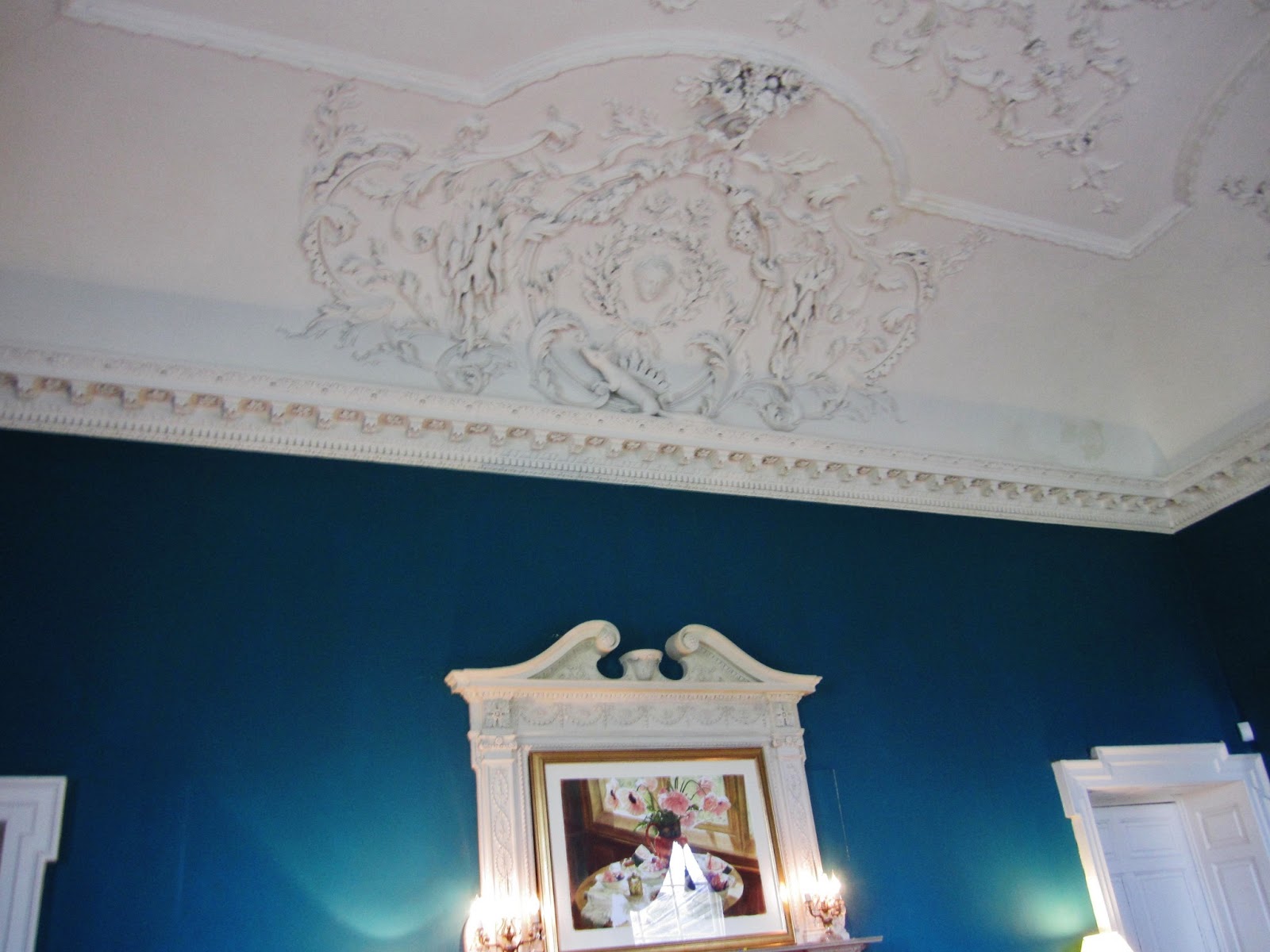
I shan’t tire you with
the minute details of the respective owners of these houses, or an extensive
treatment on the lavish plasterwork (and the controversial mystery surrounding
the plasterwork: was it the famous Italian La Franchini brothers, or an
imposter of theirs, that wrought the plaster? Was it an apprentice of the La
Franchinis? Is La Franchini actually spelled that way, or is it Francini? Do
you even need the La? Were they even Italian??? ). Instead, I will show you
nice pretty pictures and give a few general impressions:


 |
| Have some pictures of plaster. |
Houses like Riverstown
and Kilshannig are so very rare in Ireland nowadays because after independence
nobody particularly wanted to preserve big ol' mansions that had once belonged
to the English usurper. Though they are evidence of a good three hundred years
of tradition, oppression, and social stratification, as well as some damn
gorgeous architecture and decoration, most were let fall entirely into ruin or
were purposefully demolished. I don’t blame the Irish state for condoning this,
but it is regrettable that there aren’t more surviving great houses for me, a
selfish backwoods American with the historical decency of a carpetbagger, to see.
I feel that in America (good old ‘Merica) a rumpus would have been raised at
the demolition of these romantic bits of history, nationalism or no.

In any case, houses
preserved in their original Georgian states are few and far between. Both
Riverstown and Kilshannig sport the vibrant walls, ornate (La) Franc(h)in(i)
plaster friezes, and at least some elements of the Paladian style in their
construction. Kilshannig is much more grand, having belonged to a wealthy
merchant (the sort who was once a Quaker, but was asked to leave the church for
his failure to live simply and stay out of politics) instead of a Church of
Ireland Bishop, as Riverstown did. The current family to own Kilshannig are
breeders of Thoroughbreds and possess a creditable number of distinguished
family portraits and gouache-heavy modern art pieces that reportedly cost a
mint. They also were kind enough to feed the frigid band of history students
tromping through their home tea and fancy cakes, which was immensely
thoughtful.
 |
| Hand. Painted. Wallpaper. |
 |
| Staircase at Kilshannig |
Preserving such houses
sounds like an absolute nightmare and a noble undertaking. Despite the fact
that they don’t build ‘em like they used to (a witnessed by my own apartment;
twelve years old and it’s already moldering like last week’s bread), it takes extreme effort to keep out the rain, vermin, and march of the centuries. I applaud the caretakers of both of these houses for that.
Since you, gentle reader,
were not there to goggle at the JAYKERS ‘TIS A CHERUB’S FOOT PROTRUDING FROM
THAT PLASTER FRIEZE houses yourself, I’ll share some of the more interesting
anecdotes:
 |
| Behold, a headless dove |
Here is a dove whose
head was shot off by a champagne cork, let fly by reveling United Irishmen (or
some other rebel faction, it’s all apocryphal) during a siege on Kilshannig.
Only one dove cooing among the plaster leaves in the front entrance has
retained its head; the others have jagged stumps. Those rascally rebels.
 Here is a deep well. It
looks most dangerous and is surrounded by a ruined stable block with three
stories of crumbling brickwork. Quite eerie, especially when contrasted with
the glorious, perfectly preserved exterior of Kilshannig.
Here is a deep well. It
looks most dangerous and is surrounded by a ruined stable block with three
stories of crumbling brickwork. Quite eerie, especially when contrasted with
the glorious, perfectly preserved exterior of Kilshannig.
Now it is time for a revelation:
I wish to have a
Georgian house.
I care not that they’re
a bugger to keep warm, are in constant need of repair, will slowly eat away
your vast fortune, and usually visit some disaster (i.e., collapsing ceilings)
on their owners. One day, when I am by some miracle wealthy (here my parents
are shaking their heads, ruing the day I chose a major in history) I shall
endeavor to won such a house. And when students come to take a tour and ogle at
my plasterwork, I shall feed them tea and cake.


Now, one very quickly to
my trip to Cobh! It is pronounced like cove, though spelled
see-oh-bee-hhhhaych.

Cobh is a lovely little
town overlooking Cork Harbour, a body of water previously known as the Cove of
Cork, ergo the town’s name. It was once called Queenstown, as it was the first
place in Ireland to be visited by Queen Victoria, for a while; upon
independence, the Irish state, for obvious reasons, wanted to get rid of the
Queen references and thus shortened “Cove of Cork” to “Cove…” and changed its
spelling to the Irish way, with a bee-hhhhaych, because of revenge purposes.
I went to Cobh by train
early on a Saturday morning. The ride was lovely although the weather was, as I
have already mentioned, quite dour. It’s only half an hour from the Cork
station to Cobh, plus a short ramble into town along the harbor. Did you know
that Cork Harbo[u]r is one of the many locations worldwide to claim to be the
second-largest natural harbor in the world? ‘Tis a true story.
 Our first order of
business in Cobh was to get coffee to ward off the creeping damp chill. Then,
we met up with our city tour at the Commodore Hotel. We had initially booked a
boat tour of the harbo[u]r, but were informed the day before that the boat was
not running for undisclosed purposes. Therefore we had to stick to the streets.
Our first order of
business in Cobh was to get coffee to ward off the creeping damp chill. Then,
we met up with our city tour at the Commodore Hotel. We had initially booked a
boat tour of the harbo[u]r, but were informed the day before that the boat was
not running for undisclosed purposes. Therefore we had to stick to the streets.
The tour was quite
informative and focused mainly on Cobh’s designation as the last port of call
for the RMS Titanic. As the guide romantically alluded, the eyes of Cobh were
the last eyes to see Titanic… while she was still afloat. After our tour we
stopped by the Titanic museum, located in the White Star Line offices through
which the doomed vessel’s final passengers passed on their way to their watery
grave. At the entrance we were assigned identities as passengers who had
boarded in Cobh. I was Bridget Mary Sullivan, a twenty-one-year-old maid who
was eloping with her boyfriend Joe. Myself/Bridget Mary did not make it off the
Titanic alive, as I was cheerily informed at the end of the exhibit.
The museum was
well-put-together and I would strongly recommend it to anybody passing through
Cobh. However, it is an extremely sobering affair and not for the
easily-disheartened. One of the highlights is stepping out onto the balcony
upon which first-class passengers would have awaited the ferry that would take
them to Titanic, anchored off Spike island at the harbor’s mouth. It was set up
to be a beautiful moment, with the original pier from 1912 slowly crumbling
into the cove and an industrial fog rolling out from behind the island.
Unfortunately, a nearby café insisted upon blasting “Eye of the Tiger” quite
loudly from some spot directly beneath Titanic’s pier, effectively ruining the
beauty of the moment.
 |
| And he's watching us all with the eeeyyyyyyeeee... of the Tiger. |

After lunch to calm our
somewhat depressed spirits, we hiked up to the top of the town to see Saint
Colman’s cathedral, the seat of the Bishop of Cloyne and an absolutely
spectacular structure. As thanks for providing extra masses and spiritual
council before their departures for the new world, many Irish immigrants who
left from Cobh sent money back to the cathedral to build it up to be one of the
finest in Ireland. Saint Colman’s was almost entirely funded by donation, and
now I’ll let the pictures do the talking:


Now, I feel incredibly
remiss for waiting THREE WEEKS to post this. Mea culpa, mea culpa, mea maxima
culpa. Therefore I shall truncate Three Gray Tales and make it Two Gray Tales
and tack on Dublin sometime later, once I have finished this blasted essay on
European Union agricultural policy.
Warm regards,
KB
Subscribe to:
Posts (Atom)