Dear readers,
I am distressed to see that the headings of my posts have been suddenly and inexplicably styled... in COMIC SANS font.
Comic Sans, people.
The worst font ever to be drawn.
The story of the Cormorant and the thrilling conclusion to the Kerryland adventure will be resumed eventually, but for now all of my blogging breaks shall be devoted to ridding my Irelandiary of this plaguey pestilence of comic sans.
I swear this by the sword of my ancestors. And also apologize for any unhappiness seeing comic sans may have caused you.
Wednesday, February 6, 2013

Slack-Jawed Wonderment in Kerryland

Be
grateful, dear readers, that I took precisely 219 photographs of this past
weekend; without these I would be too overwhelmed to string together in any
logical sequence all the Irish wonders I saw between Friday and Sunday. As it
is I have a chronological record of said wonders, and can, in the manner of the
movie The Hangover, see a record of where I’ve been.
To
begin at the beginning, I spent the past weekend touring the rings of Kerry and
Skellig. The Ring of Kerry is one of the most happenin’ tourist loops on this
island, inclusive of many natural wonders and conveniently-spaced hotels and
restaurants and lavatories and gift shops. The Ring of Skellig is, size-wise,
no more than an orbiting moon to Kerry’s Jupiter, but is not touristy at all- I
daresay it’s authentic. I count myself lucky to have seen it.
UCC
organizes bus trips to see these rings every weekend early in the year for
visiting students, and I happened to be assigned to this weekend along with my
dear friend and roommate Mary. I was a bit skeptical of the merits of such a
trip at first (a bus tour with forty-odd other Americans? No thank you!) but,
as you will see, was soundly proven wrong by Ireland’s pervading awesomeness.
 |
| Like rainbows on the ocean. That alone was worth the trip. |
The
trip was led by a fantastic lady by the name of Marian ni Shiulliobhan who is
one of the professors of Irish language at UCC and comes from the town of
Cahersiveen in the Ring of Skellig. I greatly admire her gumption at leading
groups of loud and often unappreciative Americans with ungainly amounts of
luggage around her beloved home county, whilst keeping up a steady flow of
information, Irish language lessons, and kindness. Marian reminded me extremely
of Maggie Smith’s portrayal of Minerva McGonagall in the Harry Potter movies,
so (if you wish) you can imagine the weekend I’m about to describe being
presided over by Professor McGonagall herself.
 |
| Minerva McGonagall says "Slainte" |
We
left Cork at about oh-fourteen-hundred on Friday and sped through a maze of
winding Irish highway to reach our first destination, the Crag Caves. These are
said to be the most impressive caves in Ireland. I, for one, was nonplussed. They
were nice caves and all sure, and they featured a stalagmite shaped like a wine
bottle, which was nice, but I hail from the land of the Shoshone ice caves and
Craters of the Moon’s lava tubes. The Crag Caves, in comparison, were mighty
small and mighty tame.
 |
| Wine bottle stalagmite, not to be confused with the shish kabob stalactite. 'Twas very thrilling |
We
reached our lodgings at Cahersiveen after dark, after a drive of a few hours
narrated by Marian. The group, fifty strong and cranky, was shepherded into the
dining room at the Ring of Kerry Hotel and assuaged by ridiculous amounts of
fancy food.
A
note on Irish food: I was warned before I came that all Irish people ever et
was corned beef, cabbage, and baked potatoes. This is a lie, a dirty rotten
lie, and don’t you ever believe it. I haven’t seen hide nor hair of corned beef
or cabbage in this first month abroad and haven’t yet been faced with a single
baked potato. If you want some Irish food to stereotype, try delicious seafood,
brown bread, and ridiculous amounts of farm-fresh butter. Organic vegetables
are also very much present. While potatoes are included in this vegetable
presence, they are usually boiled, mashed, crisped into chips (fries), or fried
into crisps (chips).
We
were also fed Bailey’s-laced cheesecake for dessert. Those who led me to
believe that food in Ireland would be dismal were dead wrong.
Thus,
the fifty-strong cranky Americans were transformed into fifty-strong happy
Americans, and as such were receptive to both a talk about life in rural
coastal Kerry from a local woman and a lesson in ceili (pronounced like my
name) dancing that lasted late into the night. It included live music and was,
in my humble yet experienced opinion, quite fun as far as ceili dancing goes,
although I tore the sole off one of my boots showing off a treble reel at the
behest of the Kerry lecturer. I suppose pride cometh before a fall and all
that.
The
next morning we woke up to sun.
 |
| Awwwwww yeeeaah |
It
was an incredibly gorgeous day. After having driven through driving rain, fog,
and wind the day before, the clear, calm, bright morning was nothing short of
miraculous, particularly since the group who had come the weekend before had
been socked in by fog so as to not be able to see the sea- which is rather
close to Cahersiveen, it being a coastal town and all.
The
hotel again fed us excessive amounts of food before we loaded up on the bus and
went cruising over to Valentia island, which lies just off of Kerry across a
narrow channel. Valentia is the site of the landfall of the very first transatlantic
telegraph cable back in the year 1866, and this is not even its most
spectacular feature.
We
stopped the bus at the base of the highest mountain on Valentia and took a
quick detour to see baby calves. I’ve gotta put it out there that being
momentarily on a farm- even one that had peet stacks instead of haybales- was a
lovely reminder of home. A majority of my fellow roadtrippers were from the
cities of the Eastern coast and had never seen a cow, calf or otherwise, up
close and personal before. There was much rejoicing.
 |
| The boots of Glory |
The
group was then left to its own devices for a few hours and allowed to go
galloping around the Valentia hills. We were encouraged to hike to the top of
the (quote, unquote) mountain to get the best possible view of the Skelligs (more
on them later) and Cork and Kerry mountains to the East. As I had my hiking
boots on (‘rugged,’ ‘intrepid,’ and ‘legitimate’ would be the three adjectives
I would ascribe to them if pressed), I was ready for the trek and to reach the
top, where Marian said it was “fair enough to see clear to America.”

Fair
would be an understatement.
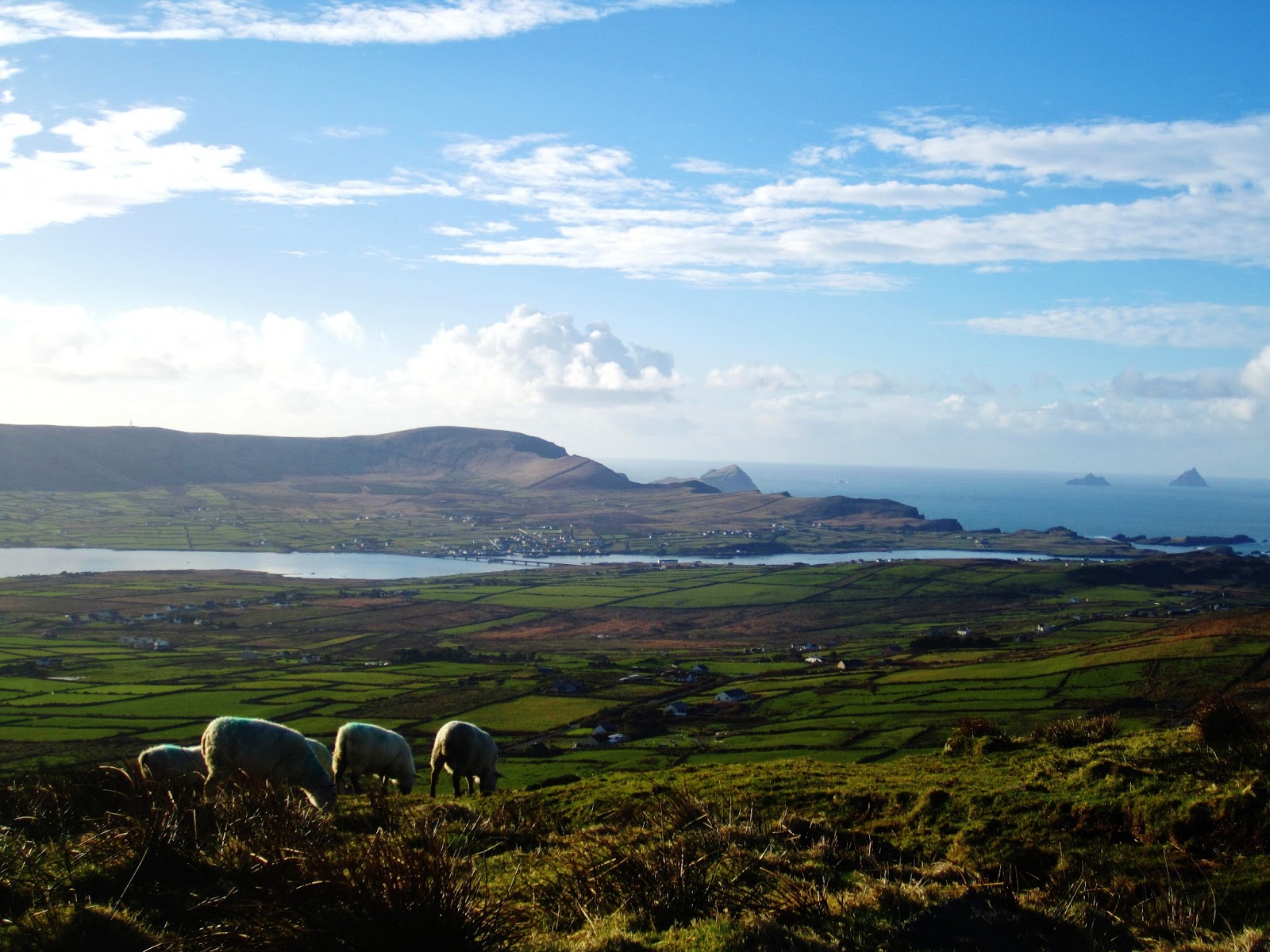
Please
bask for a moment in the glory of these photographs.

 Pretty
much the whole day was like this. I was in a constant dramatic-sighing
mouth-agape breath-intaking frenzy of slackjawed wonderment at everything I saw.
The view was incredible, and I’m fairly sure I could see the coast of America,
just barely, past the Skelligs and over the horizon.
Pretty
much the whole day was like this. I was in a constant dramatic-sighing
mouth-agape breath-intaking frenzy of slackjawed wonderment at everything I saw.
The view was incredible, and I’m fairly sure I could see the coast of America,
just barely, past the Skelligs and over the horizon. |
| And majestic sheep |
February
is consequently considered to be the first month of Spring here on the Emerald
Isle. Since we were out enjoying the glories of Kerryland on February 2nd,
it was technically the second day of spring and acted accordingly. I was
running around in a t-shirt by noon. Considering the amount of icy rain, hail,
and even snow we’ve had recently in Cork city (to complement our Arctic monsoon
winds, of course) this was impossibly splendid. I was literally beside myself
all day with sheer joy.
I’m
going to pare down this behemoth blog post and end this one here. Meanwhile, have a photo of a dead cormorant; it is a sneak peak of what's to come.

Until
we next meet, then!
Wednesday, January 30, 2013
Castles and Cashel 'n' Stuff (parte dos!)
The
cake I was baking whilst writing part one of this post turned out wonderfully.
Now I am taking full advantage of my kitchen to bake oatmeal bread, so yet
again I have an hour to kill while my dough rises.
 |
| This is the cake. 'Twas a good cake. Also my pretty roommates. |
I
believe I left off as we were leaving the historical wonderment of Cahir
castle.
We
went for lunch at an adorable café-lunchroom-type-establishment literally
across the road from the castle- this is unimportant, but I wanted to qualify
the panini mentioned last time (query: Microsoft Word wants me to capitalize
“Panini.” See, it just made it capitalized there! Is there an Italian city,
town, or principality called Panini? Even more importantly, do they have
excellent grilled sandwiches there? I shall investigate). After lunch, we
hopped back on the bus and headed to Cashel.
The
rock of Cashel is not, in fact, a rock. I suppose it is a rock in the purest
sense, seeing as it sits atop a large escarpment in the middle of the
countryside, but it is not the rock that causes tourists to flock to Cashel. Having
done uncharacteristically little research on the rock, I was imagining it to be
a large monolithic granite thing in the middle of a field. I was shocked and
awed, then, to see this upon our arrival in the town of- you guessed it-
Cashel:
 |
| that is not a rock |
It’s
a massive castle-cathedral that was once the seat of the king of Munster,
Cormac McCarthy (not the author of “The Road-” a slightly older Cormac
McCarthy, who also spelled his name Mac Carthaigh). The massive structure houses
centuries of amazing artwork, including everything from beautiful frescoes to
an ancient Cross of Saint Patrick to one gnarly sarcophagus. I should like to
be buried in such a sarcophagus.
 |
| Tapestries too! |
 |
| #fresco obsession |
 |
| Add caption |
 |
| Detail of my new favorite sarcophagus |
This
being a field trip, we had a tour guide. I have dubbed him Ronan the
Controversial. I, for one, thought that Ronan (the Controversial) did an
amazing job of explaining the complexities of Cashel’s history, although
deathly boring, mean, prickly, standoffish, cold, and many worse adjectives
were all thrown around by others on the tour. Ronan the Controversial had the
most beautiful elocution I have ever heard. His spiel was like a Keats ode performed
by Edwin Booth and incredibly smooth. It was as if he were reading from a
well-written guidebook, not off-the-cuff lecturing, and I probably missed a
good third of what he said trying to figure out just how he carried on so. If I
could mellifluously declaim in such a manner, I would often and loudly.
If
any of my charming readers come to visit me in Ireland, we are going to Cashel
and requesting a tour from Ronan. It is not negotiable.
 |
| It seems that Ronan the Controversial tour guide has snuck into the corner of this photograph |
Anyways,
here are a series of awesome, austere pictures from Cashel. Its cathedral wing
(built in the 12th and 13th centuries, dontcha know) has
been surrounded by an imposing lattice of rebar and steel that supports an
artificial roof designed to keep the creeping damps out, but really just makes
one whole half of Cashel look like a futuristic dystopian industrial build-site
of abandonment.


I
like the juxtaposition of old and new rather a lot.
Cashel
also has a beautiful cemetery knee-deep in Celtic crosses. It affords an
amazing panorama of the surrounding countryside. We got to watch a rainstorm
roll in from the South, and it was positively gorgeous.


I
probably should have thought of a more appropriate phrase up there, as “positively
gorgeous” is painfully generic, but my bread is all baked and I have some
reading to do. I shall, then, make it brief.
After
adventuring around the Rock for a while and jumping off of rocky outcroppings
and/or ancient well bases, we piled back onto the bus and made a little trip to
the Swiss Cottage. This is a lovely building that is both Swiss-looking and a
cottage. Just like it says on the package.

 |
| The river Suir, pronunciation questionable |
It
is where the great and powerful Butler family- or, alternately, the mistress of
a Butler patriarch- had a retreat back in the hills on the banks of the river
Suir. It is lovely, but was closed off for the day by the time we arrived. Hence,
our group took turns skulking around the spike-tipped fence surrounding the
house, snapping pictures and looking innocent.
Then
I took a very blurry picture of a white duck. It was a nice picture, but I have misplaced it.
Alas.
The
drive home was rainy and peaceful as could be. I was frittered from a long day
of gallivanting about the countryside, and was lulled to sleep by Liam the bus
driver’s singing for us a selection of ballads and rousing drinking songs. My favorite
was one simply titled “A Father’s Lament,” incredibly sad and about a father
travelling to Dublin to claim his son’s body after the Easter Rising (or was it
the Civil War of the ‘20s? Just know that Ireland’s history is full to bursting
with sad tales of massacres, bombs, battles, and riots). At any rate, Liam’s
sang us all the way back to Leeside (encouraging group participation on those
songs we know by heart such as “Star of the County Down” and the Irish national
anthem… except this last was in Irish, so nobody was able to keep pace).
Before
my bread burns, I will conclude by giving five solid, shiny gold stars to Cahir
and Cashel.
Until
next time!

Sunday, January 27, 2013
The Castles and Crags of Cahir and Cashel (parte uno)
Ah,
blog! It has been too long!
Today
I will tell the tale of my weekend, a tale involving wind, rain, old buildings,
older buildings, ancient ruins of buildings, rocks with sheer drops, history,
greenery, scenery, lots of roundabouts, attack pigeons, and also a really
delicious panini.
I
could just leave it at that, but I have resolved to write more often than I have
been of late- which has been not at all. There’s certainly room for
improvement.
Also,
I am waiting for a cake to bake, so I have some time to kill.
Yesterday
I woke up fairly early for a Saturday and suited up for an excursion to Cahir
Castle and the Rock of Cashel (which could have a more informative name, as
shall soon be described) in county Tipperary. It is not too long a way to
Tipperary (from Cork at least), but I was still a touch queasy thanks to the
skinny little roads and frequent roundabouts between the two. Needless to say I
was quite delighted to be met with a brisk bracing chilly and/or icy breeze
upon diembarkating the bus at Cahir Castle in the aptly named town of Cahir (pronounced
like “care”).

This
excursion (I should note) was organized by the lovely folks at USAC, which just
happens to be the program that brought me here to Cork. Myself and about
fifteen other students from all over the US of A are thusly lucky to have Mary Steele,
USAC’s contact at UCC, as our advisor, trip leader, and quasi-mother-figure for
our five months abroad. Mary, besides giving me advice on classes and providing
our group with Cadbury bars, was thoughtful enough to find us a bus driver who
was practically a brogueing, lament-singing Simon Schama. Liam (the aforementioned
bus driver) most wondrously condensed all of Irish history into a twenty-minute
lecture, delivered as he navigated Tipperary’s turnpikes and tollbooths and
roundabouts (so many roundabouts!) with much skill. In all six of my upper
division history and government classes, three weeks have hardly contained the
breadth of information provided by the good Mr. Liam. It was quite impressive.

At
any rate, we reached Cahir around 11 o’clock and made for the castle. Our tour
featured the following highlights:
1.
There
is in the outer wall of the castle a cannonball that has been embedded there
for a solid four hundred-odd years. Queen Elizabeth’s forces under Essex put it
there with one of two cannons that accompanied their force of 20,000
infantrymen and 2,000 cavalry in 1599. Why these numbers stick in my head is a
strange and marvelous mystery.

2.
The
castle features a ridiculous amount of defensive measures. I must say that my
respect for Early Medieval architects has grown exponentially. There exist
within the walls of Cahir castle such things as machiolations, which are
specially-designed openings in the castle walls used to pour boiling oil, tar,
sand, or quicklime onto attackers; air-lock-type rooms between layers of castle
that could be sealed off and collapsed with the enemy inside in the event of an
attack; arrow slots everywhere, later converted to fit guns; gnarly
portcullises; stairs built purposely of odd and mismatched heights so that
attackers would stumble whereas defending local soldiers, familiar with the
castle, would know the lay of the ground; low ceilings that force anyone coming
through the duck, making visibility difficult; and, lastly, a plethora of
spiral staircases turning clockwise, which would force right-handed soldiers (and
all soldiers were right-handed, since the left hand was still associated with
the devil) to switch their swords to their left hands as they ascended.
Defending soldiers would have the right-hand advantage coming down the stairs. SO
BRILLIANT.
3.
The
one of the last people to nominally live in Cahir castle was, technically,
Oliver Cromwell, possibly the most hated historical figure in all of history
other than Hitler. He (Cromwell, that is) took a liking to it whilst on
campaign and ousted the Butlers (Earls of Ormond, for anyone who cares about
that sort of thing) from their ancestral home. They eventually regained it, but
it gave the historian in me the creeping chills to think about that.

4.
I
haven’t the patience to write all about Irish Elk/Giant Irish Deer/Megalocerus
giganteus at the moment, for there is very much to tell about them, but I will
mention that there was an admirable rack of Irish Elk horns/antlers/??? in the great
dining hall at Cahir.

Those things are approximately 10,500 years old, and
that, my friends, is very old indeed.
 |
| My apologies if this has offended the delicate sensibilities of my discerning and gracious readers. |
5.
To
return to the pouring-hot-nasty-liquids-upon-thine-enemies tack from #2, our
tour guide informed us that up until the advent of the firearm the Irish thought
it cowardly to wear armor. They would go to war in their shirtsleeves while
their enemies where covered in a good many layers of chain, leather, and metal.
This meant that when the hot nasty liquids were poured on them, the armour
melted and had the same effect as tarring someone. Brutal. And also badass (if
you’ll excuse my French) of the Irish, doing battle in plainclothes and all.
Reminds me somewhat of their dueling rules. Honor! Glory! Rules.
6.
We
were allowed a leisurely time for walking about and exploring the castle after
the tour, and a few of the towers (used as bathrooms, where ammonia gas from
the toilet pits would be used to disinfect clothing hung above the john. Again,
extremely clever) were open. The top of one was home to an attack pigeon (one
friend submits that it was, instead, a pterodactyl) which became trapped
between myself and my fellow intrepid explorers and a locked door; its fright
was nothing compared to ours, and a near-death experience was had by all.
 |
| The river Suir from the pigeon tower. Cahir Castle is on an island in the river, ergo the whole thing is like a moat. Sooooo clever. |
7.
Speaking
of death, it was sobering to realize just how many people- Irish, English,
Butlers, soldiers, civilians- had been killed through the centuries on the
ground of Cahir castle. Compared to the Old Penitentiary (where, for those who
don’t know, I interned this past summer) and its relative deaths, which can be
counted on digits with your shoes off, the human cost of keeping Cahir castle
was staggering.

On
that morbid note I shall end this post, as my cake is baked and it’s time to
prepare for a presentation in one of my classes. I’ll be writing on the Rock of
Cashel sometime soon!
Monday, January 14, 2013
The Sage of Ballycotton
Has it really been a week since I last posted? I mean dayyyyum son. The time does fly.

This past week has been full of adventures, from getting lost in the city for the first time to experiencing my first club to taking a trip out to the coast to classes, classes, classes. SO many classes. Too many? Since international students don’t register until January 15th, we have the privilege of “shopping ‘round” for classes for the first week and a half, and I have been doing my darndest to take all of them.
But that’s not what this blog post is about! I feel compelled to share with the one person who reads my blog (Hi!) an anecdote that occurred in the tiny fishing village of Ballycotton.
But that’s not what this blog post is about! I feel compelled to share with the one person who reads my blog (Hi!) an anecdote that occurred in the tiny fishing village of Ballycotton.

One of my dear roommates, Allison, randomly chose Ballycotton out of the many small, uncharted coastal villages within a bus ride of Cork city. So, early on Saturday morning, it was to Ballycotton we did go, despite protests by various Irish people that there was “nothin’ there.”

We stepped off the bus to galeforce winds and bracing sea air. I was in raptures. We took a hike down to the low-tide line and then up across some gorgeously treacherous cliffs that looked much like something straight out of Middle Earth.
 |
| Cue epic theme |
At any rate, after a good four hours of exploring we were chilled to the bone. We ate at a swank little restaurant in town and, after wearing out our welcome there, took a second hike before heading a few doors down to the Schooner bar for some hot whiskey (new favorite beverage). It was there that we encountered the Sage of Ballycotton.
 |
| Whhhiskey |

We had been warming our hands on our boiling hot whiskies for a few minutes and chatting with the bartender about a movie with Marlon Brando that was partially filmed in Ballycotton, before the funding for it went under, when an old man staggered into the pub. He was visibly inebriated and sported a mustache of crusted Guinness foam.
The man marched up to our table and asked, in a roar,
“Do ye believe in God?”
We replied, giving the Sage an entrance to begin his lecture.
“Now I’m no professor,” (he began), “but I know a thing or two and I know this: when you’re pissed off, when you’re hating the world, you take a walk down the road,
And you listen to the birds sing
And if you see a cat,
Or a dog,
You pick ‘em up and you love ‘em,
Because that’s nature,
And nature is good.
You respect nature.”
And we nodded at this very sensible wisdom.
“Now I’m no professor,” (continued the Sage), “but I know a thing or two and I know this:”
And here, hyphenated for your reading convenience, is a summary of the three-hour lecture deliver to us by Mícheál Russell, the Sage of Ballycotton:
“
The men up in the government, they’re all wankers - all they care for is power and money - You mustn’t care for just power and money, and if you do, you won’t be happy - the men in the government don’t know how to be happy - they just need to walk down along the road, and listen to the birds sing - and if they see a dog or a cat, they need to pick that animal up and love it, because that’s nature - and you must respect nature, and nature is good - I left school at fourteen years old - my father died when he was thirty-eight - and I love my mother.
The men up in government, they’ll try to tell you how to live your life - professors at school, they will too - now it’s good that all you girls are going to school, and I like to see people gettin’ on in the world - but don’t you let those professors tell you how to live your life - they don’t know nothin’ - they don’t know how to be happy - now I’m no professor, but I know how to be happy - I just walk down the road, and listen to the birds sing - because that’s nature, and you’ve got to respect nature.
These times, they’re different from when I was growing up - I left school at fourteen - and I’m no professor, but I like to see people getting’ on in the world - and sometimes you might get pissed off - you might get tired of people telling you how to live your life - and if that happens, you just walk down along the road - and listen to the birds sing - and if you a cat or a dog, you pick it up and you love it - because that’s nature - and you need to love nature - and then you will be happy.
”
And then he bought us drinks, in a very kind gesture, because he like to see people gettin’ on in the world.
And then he wandered away from the Schooner bar, into the freezing wind and fog that had rolled in off the sea.
The bartender hurried over and apologized profusely. “He’s not from around here,” he said sheepishly. “He only wanders into town every two months or so, gets drunk, and then leaves.”
And so, we had the dubious honor of being in Ballycotton on the same day as Mícheál Russell and his wisdom.
Much refreshed, we hiked out to see the light in the lighthouse (one of the few still functioning, as most have been shut down in favor of radar systems) and bid our farewells to Ballycotton.
Now my lymph nodes feel like pillows and I will probably contract a whooping cough in the next few days, but the trip was absolutely worth it.
Until next time ~
KB
Monday, January 7, 2013
Of Gaol, Sessions, and Oliver Plunkett
As I said at this time last time, blogging is not my strong
suit, but I’m sure that we’ll carry on bravely nonetheless.
I believe I left off at orientation, which was lengthy,
tedious, and chilly, as orientations are wont to be. Still, there are some
awesome individuals hailing from both sides of the Atlantic studying at this
university, and I loved getting to meet a good many of them. Following, there was a social of sorts at yet another pub (who'd 'a thunk?), where the kind people of UCC tried to make us poor Americans feel at home.
 |
| This is a thing. |
The next morning (Saturday) the University Studies Abroad
Consortium, better known as “USAC” (and pronounced phonetically) held a
scavenger hunt for its members. Our destinations were various businesses, pubs
(always pubs), and monuments around Cork city, most of which we had located
during the past few days during our sightseeing walkabouts. I am extremely
proud to say that my team won, if only by a fraction. Our prizes were money
cards to be used at Tesco, a grocery store of sorts, and we immediately rushed
over there to stock up on foodstuffs. Free food is always a good thing. We also
took a stroll around Cork’s famous English Market, an indoor farmers’ and
artisans’ market of sorts that I can’t wait to go back to. Heck, the Queen
Mother herself visited there last year to buy some fish (or so this picture
would submit):
 |
| She is just the cutest. Look at that hat. |
 |
| Another location in which to live when I am rich |
The afternoon was spent hiking up to the Sundays Well
district on the North slope just across the river from my apartment. Besides
beautiful houses and brilliant private gardens, Sundays Well also houses the
old Cork Gaol, which brought me back to the warm, dry days that I spent
interning at the Old Idaho Penitentiary this summer.
 |
| But pretty, executions and all notwithstanding |
 |
| Gimme that bag, Mary Sullivan |
The Cork Gaol is rather a different story. Its dreary, dark
halls are full of creepy mannequins arranged in poses most grotesque and a
soundtrack of echoing footsteps, clinking irons, and bloodcurdling screams (NOT
cute) that repeats throughout the tour.
Still, as far as historical prison tours go, this one was
appropriately macabre. Four stars.
All that dank and morbidity made us altogether quite
famished, so we went to dinner at a wonderful pubs called The Oliver Plunkett.
(A historical interlude, if you’re into that sort of thing:
Oliver Plunkett was Archbishop of Armagh (which is, of course, is Ireland) during
the regime of Charles II, throughout which, if you remember from eighth grade
history class, England was in possession of Ireland, as usual, and was doing
its best to bring to heel the Catholic church, as also usual. As part of the
Popish plot, a most nefarious undertaking propagated by Titus Oates, Jesuits
were to be blamed for a (fictitious) plot to assassinate the king. Plunkett and
a number of other prominent Catholic figures were duly executed by a lame-duck
Charles who, despite his rumored identity as a Catholic, had to preserve his
throne in order to save himself from death. Plunkett, completely innocent of
any infamous scandalous treasonous plot-making, is therefore one of Ireland’s
notable saints and martyrs. His head is preserved as a relic in Drogheda’s
cathedral. Take a look at his Wikipedia page should you want to read more about
Saint Oliver, firstly because he was a very remarkable person and secondly
because his head is pictured therein.)
Where were we?
Sooooo, we went for fish and chips at the Oliver Plunkett,
which just happened to be hosting the best traditional Irish band that I have
ever had the pleasure of hearing- and I’ve been lucky enough to hear some
splendid ones over the past twenty years. We gained a new friend from UCC on
the way downtown, and it was an evening well spent eating (surprisingly
highbrow) fish and chips, getting to know our new acquaintance, and trying not
to let my feet get the better of me and go tapping away all by their lonesome
because the band was just. That. Good.
Should anyone ever be in Cork, I would behest at you (is
behest a verb? I dunno. Is now) to seek out the Lee Sessions and hear them do
their thang, because those brothas can PLAY.
Looking forward to continued adventures with good history, good
food, good drink, good music, and good company.
Until we next meet~
K.B.
Friday, January 4, 2013
In Sum
I
officially suck at blogging, and I haven’t even started yet.
I
had half a page of elegant prose (this is a lie) sitting on my computer ever
since I got it all set up in my apartment bedroom (which is, by the way,
ridiculously huge. Sometimes I roll around on the floor and make floor angels.
Or maybe I’m just used to sharing my quarters with five other people) but had
to keep changing the dates and times since I haven’t had time to put down in
writing yet just how much of everything I’ve experienced thus far.
SO,
rather late in the third night or early in the fourth day of IRELAND 2013, I give
you a brief summary, bulleted for parsimony.
1.
I
did not die on the plane. It was, in fact, lovely, and I am permanently
impressed by vegetarian plane food. They gave me curry. Mm-hmm.
 |
| And there were many clouds |
2.
We
flew over the Southern tip of Greenland. The Southern tip of Greenland. And
then, circling Heathrow thrice due to traffic, I saw such landmarks as
Buckingham Palace, the London Eye, Hyde Park, Wembley Stadium, London Bridge, Piccadilly
Circus, and Trafalgar Square not once, not twice, but thrice. I felt extremely
accomplished and all I had to do was sit there.
3.
I
passed out until we hit Irish soil at the Cork airport, and woke up to find
myself in a vaguely sunny Ireland. Of course it began misting post-haste, but I
can’t wait for the next clear day.
4.
I
was neither detained nor deported by immigration
5.
Made
it to the apartment. I have two wonderful and charming roommates and a fourth one
who is either invisible or an Irish student who will be joining us on Sunday.
6.
Either
way, my room has a floor-to ceiling window and a leeeeetle tiny balcony. Also it
is permanently frosty in there, which makes me feel Spartan. I enjoy feeling
Spartan.
7.
Pubs.
8. We took a walk ‘round Cork to obtain provisions, see the city, acquire phones and/or SIM cards, and climb to the top of Shandon belfry yesterday. It looked like this:
8. We took a walk ‘round Cork to obtain provisions, see the city, acquire phones and/or SIM cards, and climb to the top of Shandon belfry yesterday. It looked like this:
 |
9.
And
then today was orientation, which involved much brogue-ing and sightseeing and
general edumacation on Corkonian subjects. Needless to say I’m psyched to start
classes on Monday, and am currently trying to fit together a schedule to awe
the ages.
And
THAT, good sir and/or madam, has been my past three days in Cork. Now it is
time to brave the MIRA, our frigid shower-type apparatus, which also makes me
feel Spartan.
But
as I said before, I like feeling Spartan.
Until we next speak,
K.B.
K.B.
Subscribe to:
Posts (Atom)